
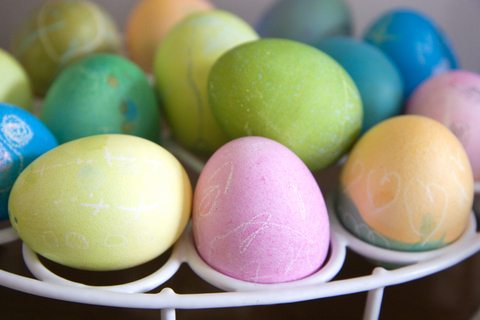
If you are preparing for Spring holidays, chances are you will be dying eggs with your children. I’m always hesitant to you commercial egg dyes. If you are looking for more natural solutions as well, simple natural dyes can give you beautiful, subtle pastel colors of Spring.
Why Eggs in Spring?
Before commercial egg laying, Spring was the time for a chicken to lay the most eggs. They need a certain amount of sunlight per day, and they would anticipate enough time in the year to raise chicks to survive the next winter. The presence of eggs from birds of all kinds was a sign of spring. It makes sense that this and other signs of new life have been adopted to symbolize the season with the world begins to warm and wake from winter.
The subtlety of natural dyes on spring eggs makes a nice contrast to the bright colors of petrochem dyes. Natural dyes also give you and your children a chance to experiment and play in creating your spring decorations.
Basic Preparation
- Eggs
- Vinegar
- Dye stuffs
- Saucepan(s)
- Glass jars (so your child can see the eggs taking on the color)
- Slotted spoon
- Tray for drying (egg carton will work, but I don’t like the smudges it can make. I like a wire rack)
If using Cool Dip method, hard boil the eggs.
White eggs show subtle colors better, but brown eggs still make nice, earthy colors.
Whether cooked or raw, clean the eggs in slightly soapy water to remove any oils or anything else that could resist color.
Dry thoroughly.
Two methods
Hot Method for more intense, sometimes mottled colors
- Put one layer of uncooked eggs into a pan. Be careful not to crack the shells or you will dye your hard-boiled eggs as well as the shells, and you will just break your uncooked eggs.
- Add enough water to cover eggs plus ½”.
- Add 1 teaspoon – 2 tablespoons of vinegar. 1 Tbs works for nearly all dyes (see below).
- Bring to a boil then turn down to a simmer.
- Simmer 15-20 minutes.
- Remove eggs from pan with a slotted spoon.
If colors aren’t dark enough yet, put eggs and dye liquid in the refrigerator overnight.
If you leave an egg in vinegar long enough, the shell will dissolve. Don’t leave the eggs sitting in dye longer than overnight.
Cool Dip Method for lighter, smoother colors with pre-boiled eggs
- Add 3-4 cups of water to a saucepan.
- Add your dye stuffs.
- Boil the dye for 30 minutes.
- Cool dye (it doesn’t have to be cool but at least take the dye off the heat before adding hard-boiled eggs).
- Add 2-3 teaspoons of vinegar.
- Put dye in a clear jar for easy viewing.
- Carefully lower hard-boiled eggs into dye with a slotted spoon.
- Leave at least 30 minutes, though you can leave the eggs overnight.
Colors
Use 1-4 cups of vegetable stuffs or 1-2 tablespoons spices.
Yellow – Turmeric
Gold/Orange – Onion Skins (vinegar moves the color toward brown)
Pink – grated Beets, crushed fresh Cranberries, canned Cherries
Purple – Grape Juice
Blue – Red Cabbage (boil 30 minutes before adding eggs)
Green – Spinach
Brown – Coffee, Black Tea
Combine for other colors. Red Cabbage plus Turmeric, for example, make green.
Techniques
Use a clear, white, or light crayon to create resist patterns. Exciting for a child just learning to write her name. Useful for making dyed eggs look like natural, speckled eggs. For an older child up for a challenge, show him pysanky (Ukrainian egg decorating) for inspiration.
User rubber bands to create simple stripes. This is a striking effect and easy to do with children.
Keep Track
This is a great opportunity for your child to learn some of the art and science behind dyes. Have them come up with a hypothesis then test it with the dyes. Does red cabbage, for example, make red dye? (It doesn’t. It makes blue dye.)
If you are going to experiment with dyes from your own garden or from your local area, you might want to keep track of the recipes whose results you most like.
What dye stuffs did I use?
What method did I use?
What was my recipe?
How long did leave the egg?
Did a different length of time result in a different color?
What do I think of the results?
Add a photo if you can.
Next year, add to your egg dye recipe book.
Throughout March we will offer guides to getting started with some of the basic practices of attachment parenting and sustainable living. This is Spring Week with ideas, crafts, and recipes.
Image © Darryl Brooks | Dreamstime.com


